

The Long-Term Memory Problem: Why Teaching and Learning Policies Fail
Schools are very good at writing policies about in-the-moment teaching. They are much worse at strategising for long-term memory and learning.

I arrive at Schoolington Academy early in the morning. I meet with senior leaders who tell me about their Teaching and Learning policy and the pedagogical strategies the school has been working on (e.g. “Name at End questioning” or “mini-whiteboards”). The policy also has information about a Do Now lesson start that features retrieval on content that students learnt some time ago.
Leaders tell me that they think the policy is good and that teachers are following it, but student outcomes don’t seem to be improving, and they aren’t sure why.
Our first approach is to see if day-to-day teaching really does match the policy. We therefore go and observe some lessons, and we see strong alignment between classroom practice and the policy. A different line of inquiry was therefore necessary to explore Schoolington’s stalled results.
I notice that in a number of lessons students are leaving a lot of Do Now questions blank. I quietly ask a student if I can borrow their exercise book. I leaf back to a lesson from three weeks ago, and ask the student a couple of basic recall questions about that lesson’s content. They cannot answer the questions. I repeat the process with a number of students in a range of subjects and years, and in almost all cases the students cannot answer the questions.
Schoolington Academy has a lot going for it. It seems to be a smooth operation, with well-written policies, effective staff training, and a positive culture around professional and institutional growth. Unfortunately, the bottom line is the bottom line, and if we aren’t shifting the dial on student outcomes, then however lovely our school is, something is clearly going wrong.
In this case, my suspicion was that despite the quality of in-the-moment teaching, there wasn’t enough focus on learning over time.
Retrieval practice, or lack thereof
We are all by now familiar with reams of psychological research that tells us that humans forget things, and they forget things fast.
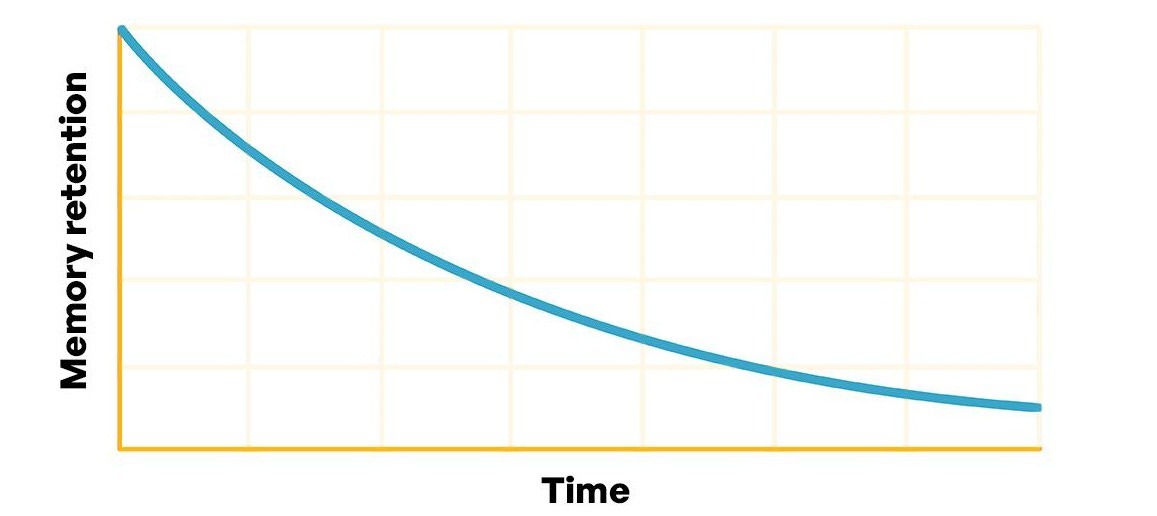
We don’t need to worry too much about specific retention rates to realise a simple but educationally-frustrating fact: however well designed our lessons, however clear our explanations, however thorough our checks for understanding and however extensive our independent practice: without a clear strategy for how students are going to remember it over the long term, we are wasting our time.
Why don’t schools do enough retrieval practice?
In order to strengthen our students’ long-term memory, we need to give them lots of opportunities to retrieve and practise their knowledge. These opportunities need to not only be extensive, but also to be appropriately spaced and spread out over time. In short, there needs to be a coherent strategy for retrieval and long-term memory, rather than an ad hoc and fragmentary approach.
In general, my experience is that this core component of the education process is strikingly lacking from schools, and students therefore struggle to remember what they learnt just a few weeks ago.
There are a number of potential reasons for the lack of systematic retrieval in schools:
Historic under-emphasis on the importance of knowledge: whilst this philosophy is thankfully waning in English schools, for many years “cutting edge” educational discourse neglected or rejected concerns around knowledge over time. Unfortunately, while philosophies might change quickly, institutional wisdom doesn’t, and saying “we care about knowledge” isn’t the same as saying “and we also know how to build it over the long term.” It will take training, innovation, iteration and time before expertise in this area spreads.
It’s hard to observe: Professor Coe’s seminal work on “proxies for learning” taught us that when trying to establish the quality of a teacher or lesson we latch onto things that are readily observable, like student behaviour, busy-ness, and if feedback is being delivered. Whether students are learning over the long term feels more ephemeral - harder to observe and requiring more effort and skill to interrogate.
There isn’t enough time: it isn’t controversial to claim that most teachers struggle to finish their curriculums. In the frantic scramble to get through the course, we then end up de-emphasising long-term consolidation in favour of short-term coverage.
It’s depressing: asking students questions about things you taught them and discovering that they remember nothing is difficult and frustrating, and most of us will consciously or subconsciously try to avoid getting into that situation.
Me dying inside as my class struggle to remember something they really should know.
It’s difficult to plan: thinking about long-term memory requires a lot of planning. Which questions are we going to ask? How many times? What spaces should we put between them? How do our plans change if they struggle? Because these difficulties are often left unaddressed, teachers and leaders default to more short term strategies.
Seductively simple solutions seem to be within reach: asking colleagues to do a Do Now with a handful of retrieval questions feels like a good solution to the problem. It’s in Rosenshine, it’s in Teach Like a Champion, and lots of high-performing schools are doing it. So when we do it here in Schoolington, we think we’ve sorted it. Unfortunately, without substantial depth of thought and planning (see previous point), this approach will be woefully inadequate (check out Carl Hendrick’s fortuitously recently published piece on a similar theme here).
Schools drastically overestimate how easy it is to implement homework: because of the time constraints, schools often offload retrieval practice into homework. In principle, I agree with this - homework is a great opportunity for retrieval practice - but it’s not an easy option. Homework is extraordinarily difficult to get right, and in most contexts it just becomes “set and forget”, where teachers set the homework and potentially check who has done it, but then cease their engagement with it. They do not give feedback on the content, nor do they use it to plan or adapt lessons. Ordinarily, beyond choosing a topic, they aren’t even involved in dictating the specific curricular content that students will be engaging with. When teachers “set and forget” they therefore communicate that they don’t really care what students do, so long as they do it. But if the teacher doesn’t care, the students certainly won’t.
It is my belief that in many schools, the lack of a proper approach to long-term memory serves as a lead weight on outcomes. When students turn up to exams their knowledge is fragmented, idiosyncratic and cannot cohere into an expressible form. They stutter and stumble, and performance can seem frustratingly at odds with the quality of in-class pedagogy.
The road ahead: questions for leaders
There are, to be clear, no easy solutions to this problem. This, of course, does not exempt us from trying. The road might be long, but it can be travelled. It starts by teachers and leaders recognising the problem, and committing to solving it. It then requires us to think hard about planning:
Have we codified our curriculum in a way that lends itself to retrieval practice?
Have we planned out when and how we will deliver retrieval practice?
Do we have strategies in place that will help us respond to students’ knowledge over time?
Do we know how to increase the number of students doing high quality retrieval practice at home?
As mentioned, none of these questions are easy to answer. But, to my mind, we need to hold to one simple truth: if we have not adequately strategised for long-term learning, nothing we do in the class can compensate. We need to scrutinise our teaching and our leading and wonder: have we been looking in the wrong direction?
Carousel Learning is designed with the questions above in mind, and uniquely poised to support your school in building a long-term memory strategy. You can find out more about Carousel Learning here and its impact on long term learning here.. You can also download our free book Retrieving Better here or attend one of our free webinars on retrieval practice or homework here.
The embedded video is taken from the Carousel Teaching CPD platform. Carousel Teaching has courses on a range of short-term and long-term teaching strategies, and you can find out more here.
Dear Adam, I totally agree with you, and yesterday I published an article about our (as adults) responsibility. If you have time, I would like to know your opinion.
https://open.substack.com/pub/boordi/p/mutagenic-chickens-why-adults-are?utm_campaign=post-expanded-share&utm_medium=web
Spaced practice is without question an integral part of learning and there is an overwhelming body of literature and research suggesting it is not simply adventagous, but a non negotiable. I would highly recommend. Sanjay Sarma's book GRASP to anyone who wants to understanding spacing and it's necessity at each level of of the heirarchy of learning.
But why do school often fail to prioritise it or implement it well? Like all things in school I think it comes down to the preoccupation of leaders: 'measurement and accountability'.
Over 20 years of being in the profession most leaders are absolutely preoccupied with the now, even when they exclaim they are interested in the process of learning. To often they have little to no band width in truly understanding the process of learning as leaders are time poor.
Consider this. The main methods of accountability I have been subjected to are observations of between 5 and 30 minutes in one lesson, a book review (where unless I'm the head of dept Im not normally part of) and the outcomes of students in their exams. None of these accountability measures really consider the context of the 'now' beyond the superficial as the QA cycle is an unforgiving mistress.
The 'observation' is without question the tool that leaders are preoccupied with to 'understand' learning. It is often done because it's on the timetable and the leader 'had' to QA the teacher as part of the school Teaching and learning policy. How often do observers really engage with checking the curriculum to see when the knowledge being taught in the lesson they witnessed was last delivered or when it is next scheduled to be assessed? Do the observer's come back to check it has been redelivered in a timely fashion? Do they even ponder this with the member of staff at the debrief? Cynically, my head says no because it would require genuine planning and real collaborative engagement with staff. It is much easier to make a learning judgement in that moment and extrapolate (guess) from there.
Similarly, we turn to the book scrutiny. This QA tool is a favourite of leaders butt is actually worse. How often I have been in a room where a leader (often with no real understanding of the knowledge from a subject) flicks through a book and makes sweeping statements about the learning or progress of students knowledge. Firstly, this is rarely done in collaboration with the member of staff in the room to discuss what is seen on the pages and the teachers explanation of the learning sequencing that was seen. Likewise, I cannot recall any point when a leader said X was done on the 13th of, let's look for evidence of when it was seen again. Secondly, and probably most importantly a book scrutiny is an assumption that written work can be evidence of learning. As Adam has shown me in a previous meeting anyone can be fooled into believing that students are actually doing spaced practice simply by a student using a normal pen and green pen when the teacher shows the solution on the board.
Finally the outcomes of the external assessments. Granted, the summative assessments can show the outcome of spaced practice, however they do not show the process of spaced practice. There is no genuine attempt to acknowledge at an external level the progression from KS4 baseline to end of course. Likewise, the leaders of school often dismiss out of hand any argument of a students starting point at KS4 especially if it doesn't fit the narrative of 'expected' starting point. To do so would to admit that the school has not implemented a spaced practice KS3 curricula in a way that leads to genuine progress early in a child's journey at secondary school.
So what is my point?
Sadly, until school leaders change their fixation on measuring success of students (and ergo teaching quality) in moments in time spaced practice will always be seen as a nice sound bite used to keep the wolves from the door.