

Every student, every lesson
When we allow the loudest voices to dominate classroom conversation, we neglect to show respect and dignity to all our students, forgetting that every voice needs to be heard.

Consider the scenario below:
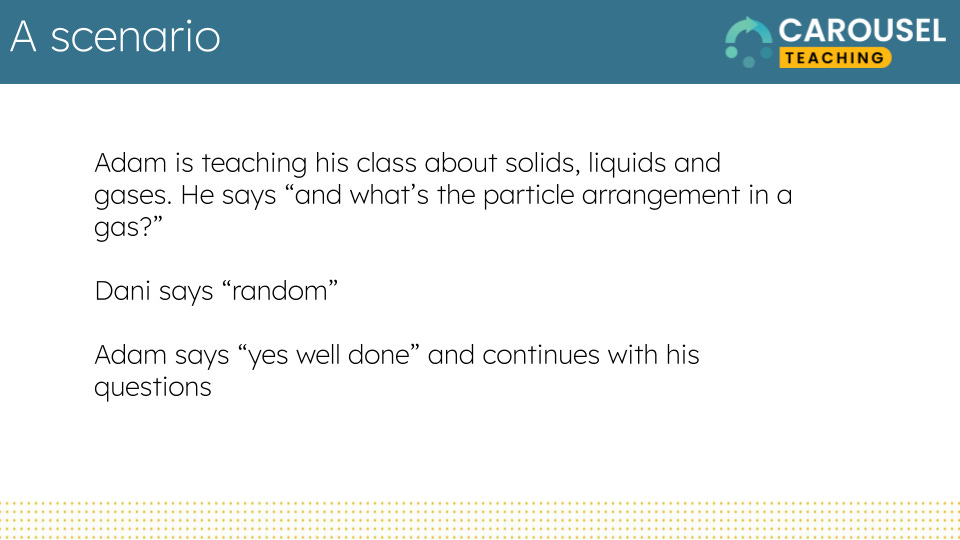
This scenario is one we use a lot at Carousel Teaching, and before reading on, take a minute to think about it and try to spot any problems.
You may have started by thinking about the fact that I (Adam) have asked the question rather than just stating the fact (“and as we know, the particle arrangement in a gas is random.”) This gives students the opportunity for retrieval, potentially strengthening their learning. Unfortunately, the positives stop there, and you will probably have noticed some problems.
You may have picked up on an assessment problem, which is that I only get an answer from one student. I could have asked the question on mini-whiteboards, and received answers from the whole class instead. Whilst imperfect, even a choral response (“say your answer all together on 3…”) would have been more effective here.
You may also have spotted the fact that Dani is giving her answer unbidden. I haven’t asked her to speak, she’s just blurted out an answer. Most teachers would refer to this as “calling out.”
Calling out
I see this a lot, where a student isn’t being rude or malicious, or trying to be a class clown, but is calling out nonetheless. It’s deeply problematic for a lot of reasons, including potentially leading to a noisy classroom, or one where the teacher isn’t fully in control (not to mention the assessment problem above). It can also lead to substantial attention loss: in classrooms dominated by calling out (or hands up), a good number of students will simply stop listening.
These problems are straightforwardly related to learning. Bad assessment means bad classroom decisions, bad behaviour means less time for learning, and a bad culture of attention results in students taking in substantially less. Despite the scenario above being relatively common, I don’t think the issues it raises are particularly controversial.
There is, however, an additional problem; one that doesn’t relate to learning, and is more moral and ethical in origin: it’s perfectly conceivable that there is a student in this class who is paying attention, listening, and learning, but across the course of the lesson never has their voice heard by their teacher. That there are students, in your class and in your school, who might go a day, a week, or a month without their voice being heard by a teacher.
Respecting our students
This is a problem, not because it necessarily leads to worse learning, but because it is ethically wrong. One of our duties as teachers is to secure our students’ academic success, but we also - regardless of academics - have to show them unqualified and unrelenting respect and dignity. But what does it say about us if we don’t hear their voices? If they can sit in front of us for an hour, and we barely recognise or register their existence? That their thoughts and opinions are excluded from our classroom conversation?
One of the ways in which we respect other humans is by seeing them and hearing them, and by showing them that their contributions matter and are sought. If we allow our classroom conversations to be dominated by a few loud voices, we fail to respect all of our students.
Every student, every lesson
I therefore have a simple rule with every class I teach: every student answers at least one question every lesson. I have other questioning rules too, but this one takes priority over everything. If I am going to show my students that I respect them and their place in the classroom, I need to hear their voices.
When I communicate this rule to other teachers, I am often met with a little resistance. Sometimes people tell me that it isn’t physically possible, and that there isn’t enough time in a lesson to get through 30+ students. Of course, this depends on the length of your lessons. I’m really lucky in that lessons in our school are long, so it’s easy to get through everyone in one lesson. If your lessons are less than 50 minutes long though, the first thing to bear in mind is to not underestimate the number of questions you - and most teachers - can ask in a short amount of time. For example, I recently shared online the video below from one of my year 11 lessons:
The video is taken from the Carousel Teaching CPD platform, and in it I ask 9 questions, six of which go to different named students. The video is one minute and 27 seconds long, and there are 34 students in the class. At this frequency of questioning, getting through all students in the class would take just over 9 minutes. Of course, my lessons aren’t spent entirely in verbal questioning, and some sequences might have more frequent or less frequent questions, but the numbers hardly seem insurmountable. In advance of publishing this blog, I kept count in a lesson I taught yesterday, and had got through all 32 students within the first 24 minutes.
Similarly, sometimes people ask how I keep track of which students have or haven’t answered. It’s a good question, and some might advocate for a tally or tick chart. I think that’s fine (provided students don’t know you’re doing it), but I also think most typical teachers can roughly keep track in their heads. Additionally, if we are aiming to do it every lesson, then across the course of a couple of lessons the probability that we will include everyone is extremely high, even if we don’t get absolutely everyone every lesson.
Student anxiety
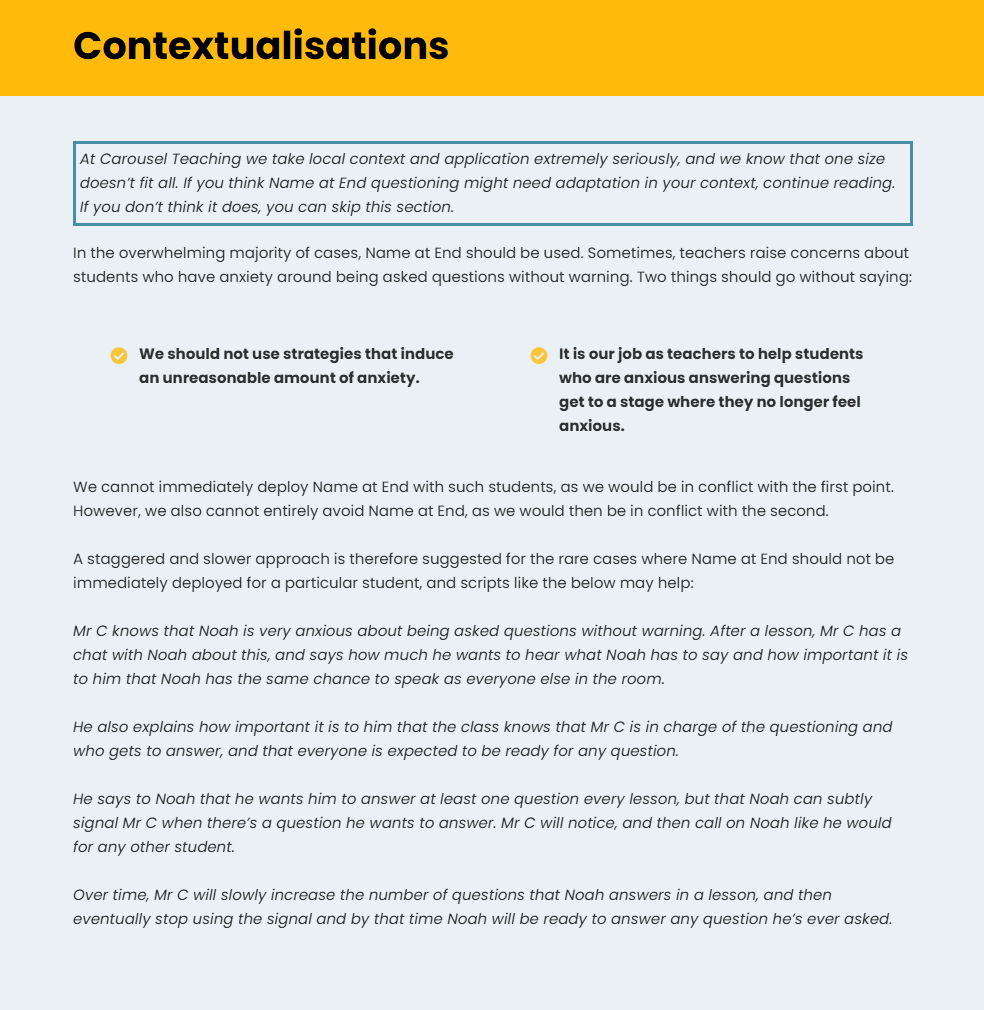
Another objection is that some students are simply too anxious to answer questions in class. This is an extremely reasonable concern, but one that hinges entirely on the definition of the word “some.” How many is “some”? 50%? 10%? 0.1%? And how does “some” change depending on context? A student might be too anxious to answer questions in a classroom dominated by noisy peers calling out answers and making jokes at each other’s expense, but completely fine answering them in classrooms that are calm, quiet and predictable, and where everybody’s voice is given an open and respectful hearing.
We also need to acknowledge that a really important part of a teacher’s job is refusing to accept the status quo. If a student cannot read, we teach them how to read. If a student cannot count, we teach them how to count. If a student cannot voice their opinion in public, do we not have a responsibility to attempt to teach them how to do so? Of course, we do it kindly and respectfully, and we accept that we might not succeed. But the idea of not even attempting it strikes me as running counter to everything we believe about the purpose of education and schooling as an ennobling and transformative act.
I’ve attached some more resources to help with this below, but to me it doesn’t feel so complicated. We start from the intended end - a classroom where everybody’s voice is heard, welcomed and respected - and we build slowly and steadily towards that point. Anything less violates our ethical duty to our students.
To learn more about better methods for questioning your classes and maintaining a high-participation class conversation, sign up to our questioning webinar here, or check out Carousel Teaching’s complete suite of questioning resources and courses here.
Additional content from Carousel Teaching on how we address anxieties around students answering questions is below. It is taken from our course Supercharge Your Questioning.
It's wonderful to be reminded every now and then, about one of the important joys of teaching: it is "an enabling and transformative act"; we do it for the young people in front of us. So to consider the respect they deserve to have their voice heard is a welcome reminder. Cheers Adam 👍🏼
Great post, Adam.
The clarity of your writing means each of the questions that started to form as I read through it were answered by the end. Typified by the 'here's some additional ways to support students who may be anxious about voicing their thoughts link.
Thanks for sharing 👍